If the tourbillon is so ‘extra’, then why are watch lovers still obsessed with it?
Advertisement
Obsessions
If the tourbillon is and so 'extra', and then why are watch lovers still obsessed with information technology?
Nosotros'll respond that past exploring the beautiful, crazy and largely unnecessary globe of this hypnotic complexity.
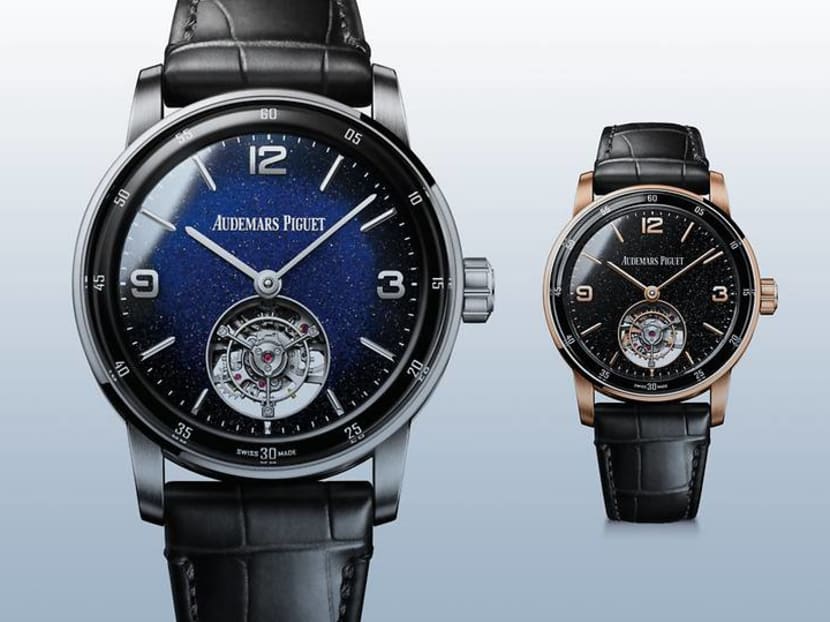
Audemars Piguet recently unveiled a pair of Code xi.59 Selfwinding Flight Tourbillons, with new dials fabricated of blueish aventurine in a white gold case, and black aventurine in a pink golden case. (Photo: Audemars Piguet)
18 Jan 2022 06:30AM (Updated: 09 Jul 2022 01:20AM)
In the meridian world of haute horlogerie, the tourbillon is probably the most popular complication that doesn't really do anything.
It was invented over 200 years agone by Abraham-Louis Breguet to help pocket watches fight the pesky effects of gravity on the move. Because pocket watches were often merely in two positions (upright in a pocket or flat on a surface), its delicate inner mechanisms would suffer from unilateral drag caused by earth's pull.
To circumvent this, Breguet devised a small cage in which to mount the most important components – the escapement and balance wheel – and had it constantly rotate then equally to negate positional errors. He called it a "tourbillon", significant "whirlwind" in French, and earned a patent for it in 1801.
READ> Would you pay a deposit for a scout and so await several years to get it?
Information technology was ingenious, mesmerising and useful. But as the world slowly moved onto wristwatches, quartz watches and in some cases no watches at all, the tourbillon became irrelevant. So instead it simply persisted through sheer beauty and the pursuit of excellence.
Tourbillons still aren't easy to design or make, often requiring at least forty parts to put together. In the luxury sector, where everything relies on flex, tourbillons have become a way for the most adept of watch brands to bear witness off their know-how.
The many impressive permutations of this not-at-all-humble complication has evolved into arguably justifies the actress zeroes they add to their watch. If a lookout man has a tourbillon, chances are it volition be the first thing y'all look at – and information technology will be hard to expect away.
Here, we break down the various types of tourbillon that y'all might detect spinning away merrily on your dial or case back.
WATCH> Why this Japanese watchmaker takes up to one year to make a single timepiece
Flying TOURBILLON
The flying tourbillon gets its name from its suspended appearance on the dial. It is supported not by a typical height span but from i side only, thus offering a better view of the mechanism.
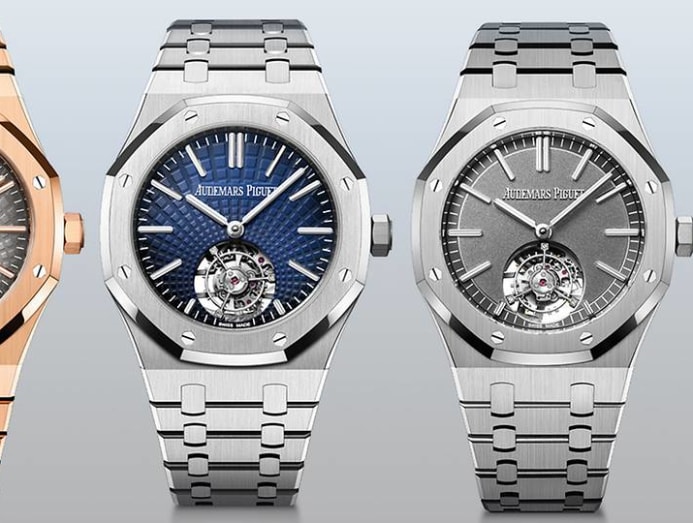
Audemars Piguet released a slew of them recently for the Royal Oak (a first for the line) and the Code xi.59. The former now offers 3 new references in pink golden, titanium, and steel respectively, while the latter presents new dials made of black aventurine in a pink gold case, and a smoked blueish punch in a white gold case. All are powered by the self-winding Calibre 2950.
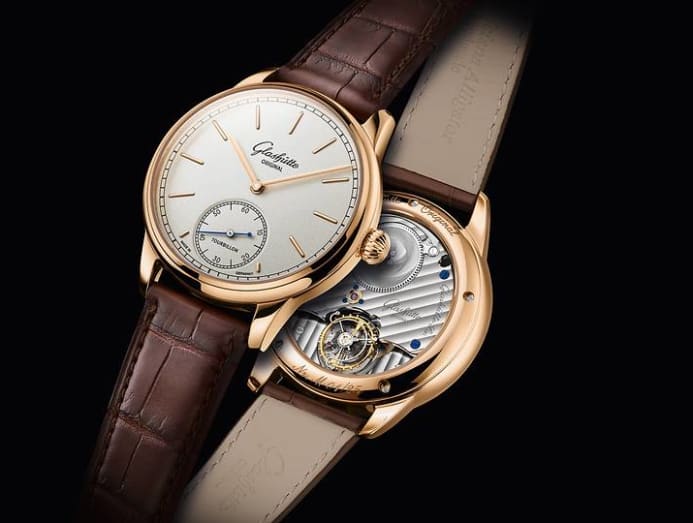
The invention of the flying tourbillon is almost ofttimes credited to Glashutte watchmaker Alfred Helwig in 1920. And then to celebrate its 100th ceremony in 2020, Glashutte Original unveiled the 25-piece limited edition Alfred Helwig Tourbillon 1920, a scout so truthful to the era that inspired it that it actually hides the tourbillon to keep the punch make clean and unassuming. You lot'll still be able to adore its structure, likewise every bit the remainder of the motility's ornamentation and finishing, from the exhibition case dorsum.
MULTIPLE-Axis TOURBILLON
Regular tourbillons rotate on only i axis, spinning effectually neatly in a circle (normally) once per minute. So multi-centrality tourbillons are ones that spin on ii to three different axis points with a goal to cancel gravity'south effects in any possible position.
Thomas Prescher was the first to accomplish a multi-centrality tourbillon in a wristwatch in the early 2000s, only complication powerhouse Jaeger-LeCoultre followed closely behind, and its Gyrotourbillons are some of the most famous examples today.
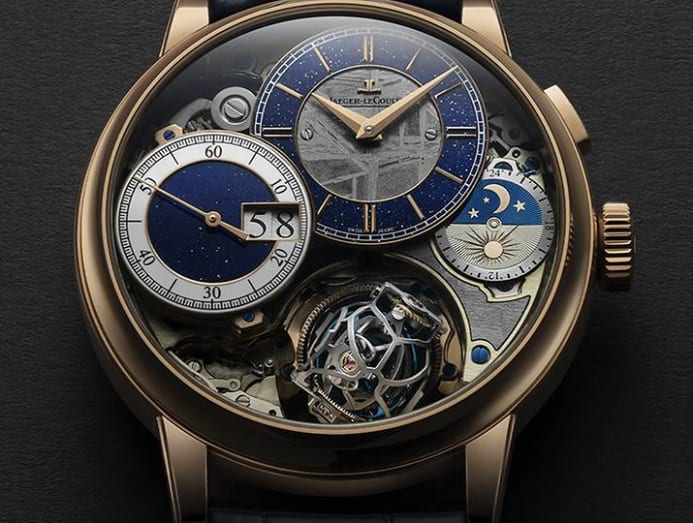
Its last incarnation was the Gyrotourbillon 3 Meteorite from 2019, a starry facelift based on the original Gyrotourbillon three from 2013.
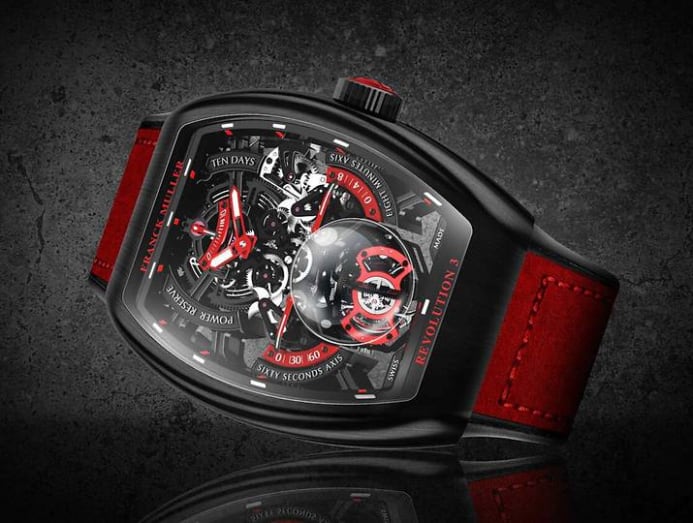
There'due south nothing subtle about multi-axis tourbillons to begin with, but Franck Muller's new Vanguard Revolution 3 Skeleton volition brand certain you never forget what it is you're wearing. Part of the sapphire crystal is domed on the front and back to act as a magnifying glass for the triple-axis tourbillon.
MULTIPLE TOURBILLONS
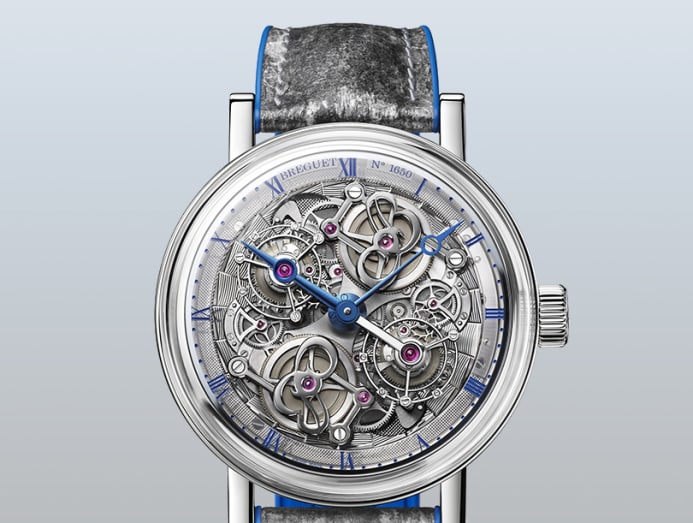
Another solution watchmakers take is to just throw more tourbillons at the problem, and information technology'due south often also a actually flamboyant 1. The Breguet Classique Double Tourbillon Ref. 5345 Quai de l'Horloge exposes the entire movement in its full glory, and the plate on which information technology is mounted actually rotates along with the hour hand. Each tourbillon is driven by its own barrel (shaped like a Breguet "B"), and the combined output is averaged past a central differential.
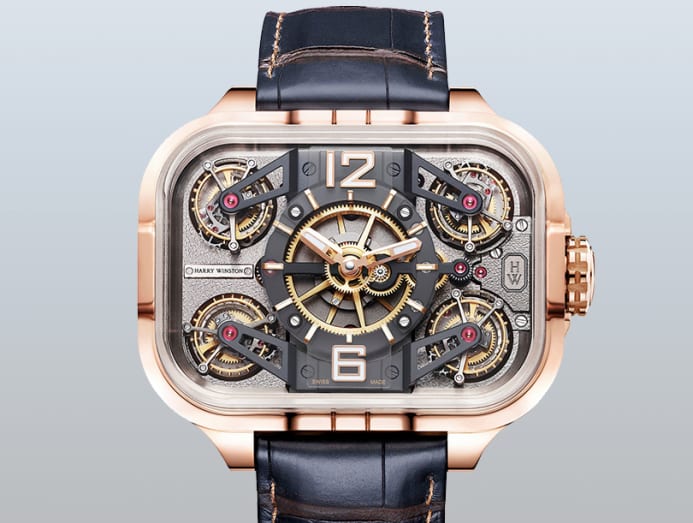
Harry Winston seems to believe more is more, so its Histoire de Tourbillon 10 – the final watch in a tourbillon series that began in 2009 – has iv of them. Unlike Greubel Forsey's quadruple tourbillon watches, the Histoire de Tourbillon x is the first to to incorporate 4 tourbillons with four separate balances. All the tourbillon cages rotate in one case every 36 seconds, while the tourbillons themselves run at four slightly unlike rates, requiring three differentials to boilerplate an output for the fourth dimension.
CARROUSEL TOURBILLON
The genius of Abraham-Louis Breguet earned him a neat many fans, one of them a Danish watchmaker called Bahne Bonniksen. If the name doesn't ring a bell, it'southward probably because his invention is a adequately obscure one.
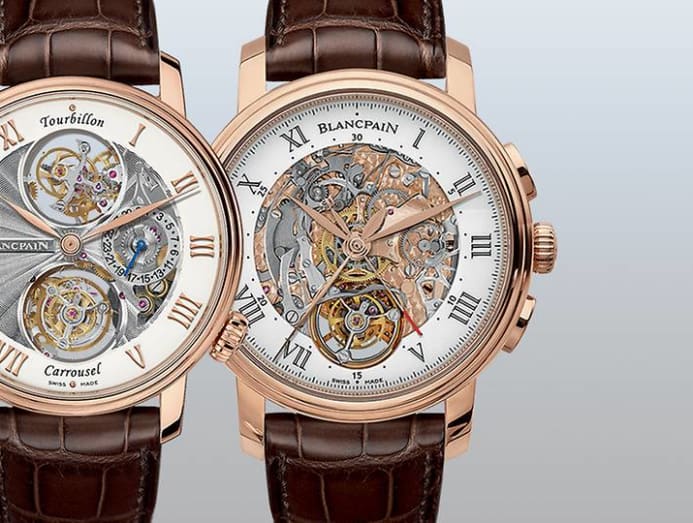
In wanting to create a more than robust alternative to the tourbillon, Bonniksen invented the carrousel in 1892, which is basically a tourbillon with a slightly different construction. Different a tourbillon, a carrousel doesn't have a cage and instead has the escapement and remainder mounted on a revolving platform. It also uses ii rather than 1 source of power to enable its rotation.
Blancpain is perchance the only big player associated with carrousels in wristwatches, and its examples easily rival (and in some cases surpass) many of its tourbillon peers in terms of artistry and construction. The Blancpain Tourbillon Carrousel in item is a wonderful manner to run across both in action at the same fourth dimension.
RECORD-BREAKING TOURBILLONS
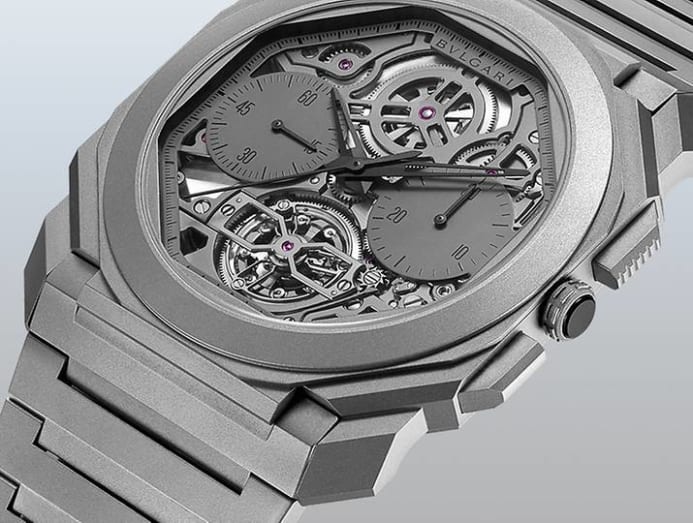
There'southward nothing like beating everyone else at a actually specific game to harvest some cachet. When it comes to really skinny tourbillons, Bulgari hasn't taken any chances. Terminal year's Octo Finissimo Tourbillon Chronograph Skeleton Automatic is the thinnest watch with that combination of features (7.4mm thick), while the Octo Finissimo Tourbillon Automated breaks the records for thinnest automatic sentinel, thinnest automatic tourbillon, and thinnest tourbillon all at once with an overall height of 3.95mm.
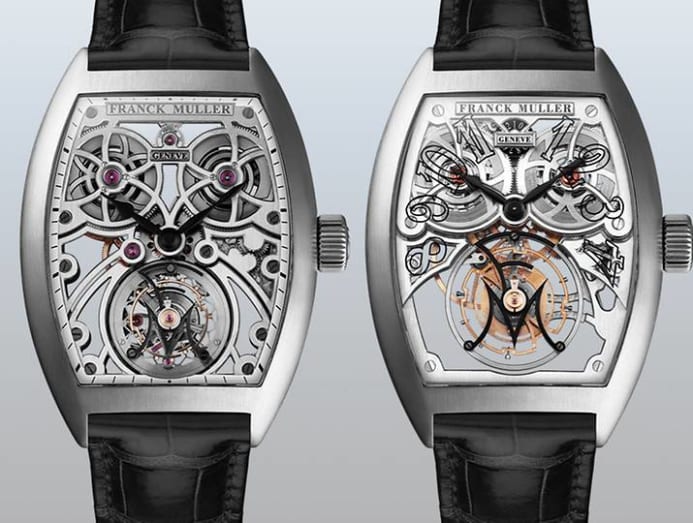
For pure spectacle we accept Franck Muller with records for the fastest ever tourbillon, likewise as the largest. The Thunderbolt Tourbillon, which debuted in 2012, completes one rotation in but five seconds where the standard is 60. A twelvemonth before that, Muller released the Giga Tourbillon, which had a tourbillon cage measuring an amazing 20mm, nigh double the size of most tourbillons.
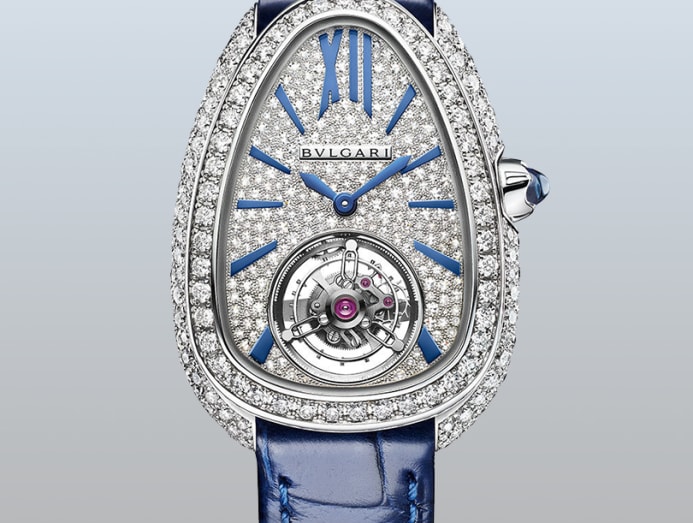
Every bit for the smallest tourbillon movement around, that award goes over again to Bulgari with the Calibre BVL150. Measuring merely 22mm by 18mm with a thickness of 3.65mm, it debuted in 2022 in the Bulgari Serpenti Seduttori.

Recent Searches
Trending Topics
Source: https://cnalifestyle.channelnewsasia.com/obsessions/why-wristwatches-still-have-tourbillons-246731
0 Response to "If the tourbillon is so ‘extra’, then why are watch lovers still obsessed with it?"
Post a Comment